While many worry about the ways in which artificial intelligence will change and replace human labor, much less attention goes out to the human labor needed to make AI work. However, a lot of human effort goes into AI development, before the technology is ready to automate any jobs. AI is a complex product with a dispersed, global production chain. Along this production chain, there are many injustices at play. Therefore, AI ethicists should not only discuss the future of work, but also the present reality of AI production.
Mapping AI labor
In a recent article, titled ‘Making AI Work: A Critical Theory of AI Production’, Prof. Dr. Jean-Philippe Deranty (Macquarie University, Australia) and I map the different types of human labor involved along the long lifecycle of AI. For each type of labor, we describe what forms of precarity and power asymmetries are at play. We distinguish five stages of AI production:
- Hardware development: involving physical labor like mining, material extraction, chip manufacturing and transportation.
- Data preparation: involving microtasks like data creation and annotation, often outsourced to workers in the Global South and margins of Western societies, via gig work platforms.
- Model development: involving higher skill data work of data scientists, AI architects, and AI engineers.
- Use: focusing on testing, quality assurance, policy compliance, and so on.
- Disposal: largely informal work related to the processing of electronic waste.
This map of AI labor is meant to show that creating AI applications is about more than model development. Even the kind of jobs that are only indirectly related to AI – such as mining and transportation – form a necessary step towards the end result that is AI. Hence, when we talk about ‘AI workers’, we should consider all workers whose efforts contribute to the availability of AI. Furthermore, mapping the production chain of AI shows that AI labor is performed throughout all corners of the world, whilst the end products are used almost exclusively in select regions of the world.
Hiddenness and injustice
In recent research on the sustainability of AI, my colleagues at the Bonn Sustainable AI Lab revealed the different types of environmental costs involved along AI’s lifecycle. AI’s energy-, water-, and resource-consumption often remains hidden, because people tend to think of AI as an immaterial product that exists somewhere in the cloud. But the cloud has a material reality. Analogous to AI’s environmental costs, are the hidden social costs involved along AI’s lifecycle. By focusing on AI’s ability to automate human jobs and everyday tasks, one tends to forget that AI is a product of human creation, with a social reality.
The hiddenness of AI workers feeds misrecognition in the normative sense. AI workers are physically hidden from the public gaze because one works at home (platform work), in a part of town where only the poorest go (e-waste processing), or in a mine in remote regions. Such physical hiddenness from the public gaze directly contributes to having one’s physical and psychological well-being overlooked. This misrecognition is aggravated by the lack of legal recognition in the form of formally established and legally enforced working conditions.
Furthermore, hidden AI workers lack esteem for the value and importance of their contributions to the successes of AI technology and the tech industry. This failure to recognize and esteem the contributions of different types of workers to AI can stem from both naivete or intentional dismissiveness. Either way, the hiddenness of the AI workers mapped above displays both a class struggle and a power asymmetry between the Global North and the Global South. Hiding and ignoring the fact that human labor is needed to make AI work, as well as the precarious working conditions involved in such AI labor, reflects a lack of solidarity among members of the global society.
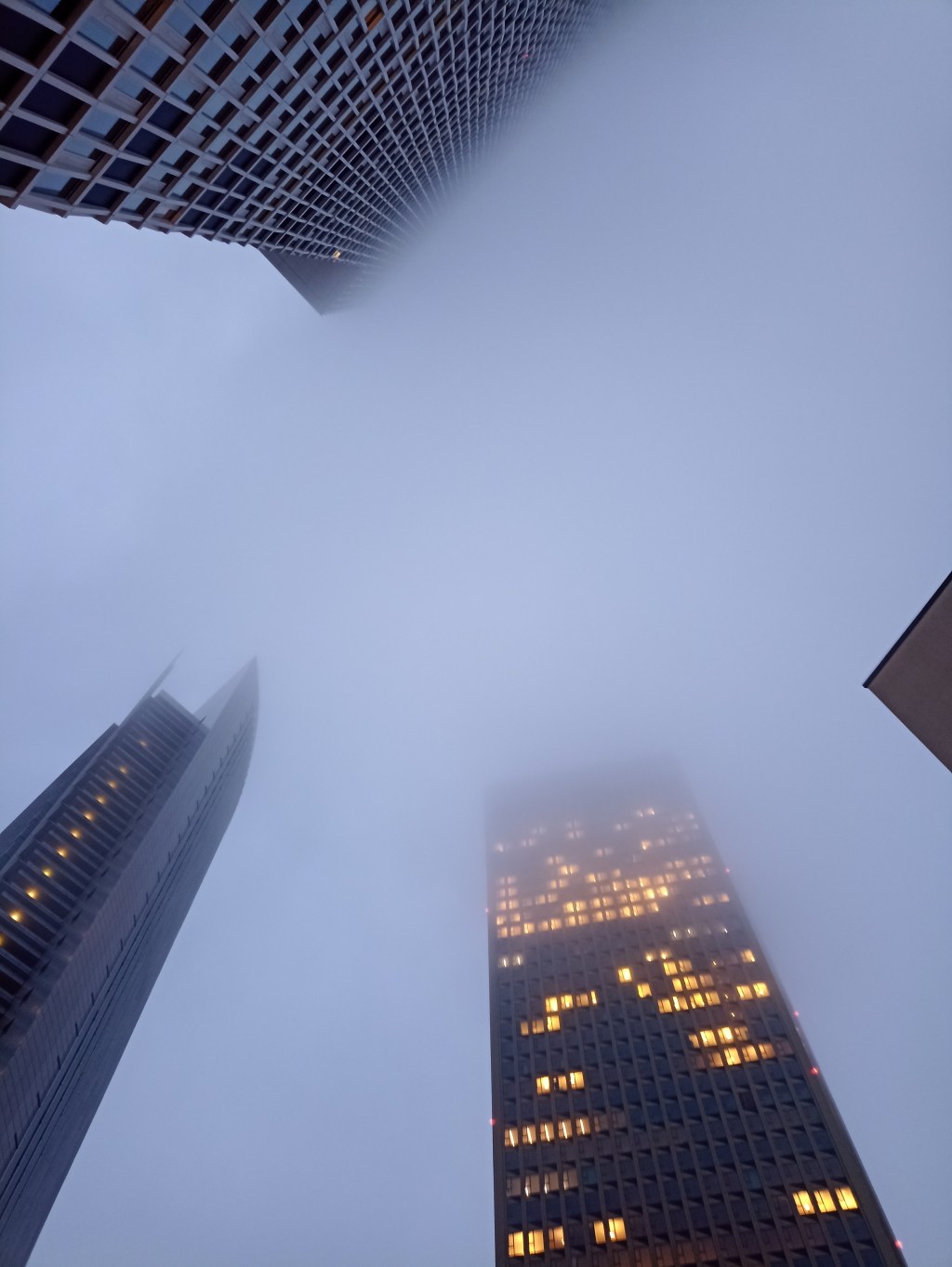
The AI skyscraper
In 1930, critical theorist Max Horkheimer compared modern society to a skyscraper, in which each floor of the tower represents a different social layer. Horkheimer explained that the top of the skyscraper is occupied by the capitalists who own the means of production, right below them are wealthy landowners and those with powerful jobs, followed by professionals like professors and engineers. Further down the tower are craftsmen, grocers, and farmers. And at the very bottom, we find “the actual foundation of misery on which this structure arises” (p. 66-67). Horkheimer writes that those on the upper floors of the skyscraper enjoyed a beautiful view, while those in the basement find themselves in a slaughterhouse.
The AI industry resembles the skyscraper that Horkheimer described. When one considers the global scale and entire lifecycle of AI, one comes to see that the power asymmetries between tech-users and the billionaires that own big tech companies are only the tip of the iceberg of injustices present in the field of AI. Following Horkheimer’s image of the skyscraper as a metaphor for the social layers of a society, the tech-users in the Global North should be understood as located in the upper half of the skyscraper, where the cathedral-like top floors may be out of reach, but the slaughterhouse at the bottom of the tower also remains out of sight.
Interested? You can find the full article here: https://onlinelibrary.wiley.com/doi/full/10.1111/1467-8675.70053


Leave a Reply