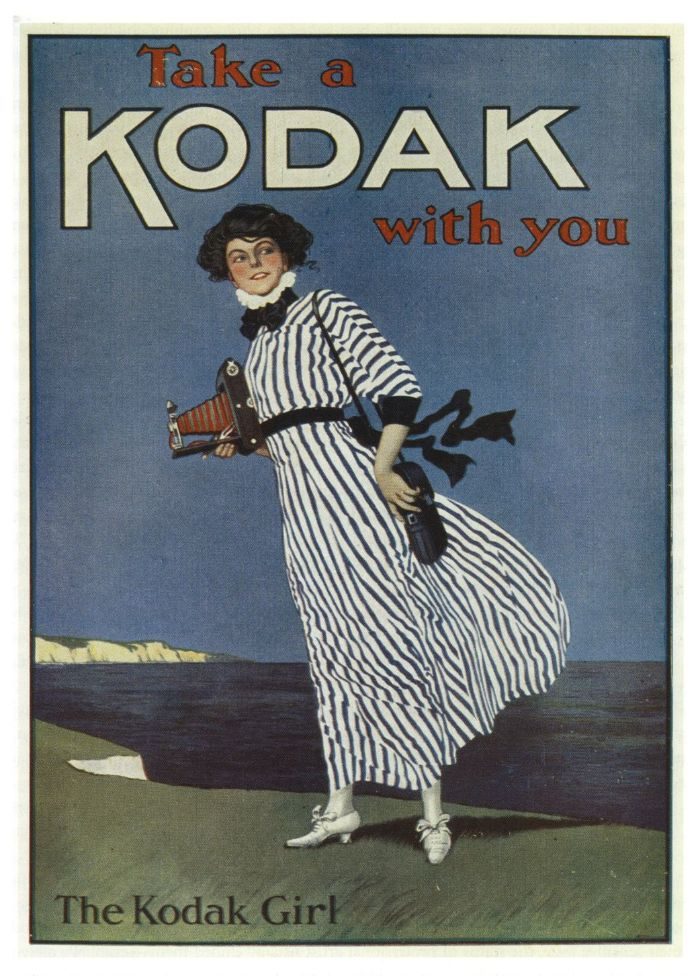
Will Kylie Jenner be able to do for Meta AI Glasses what the Kodak Girl did for personal photography? In June 2026, Meta released a new type of AI-powered smart glasses, in collaboration with influencer Kylie Jenner. Meta’s previous versions of AI glasses received bad publicity earlier this year, after it had been found that Meta AI Glasses have been used in misogynistic ways and that dataworkers in Kenya have to watch unintended intimate footage of users. Will Meta’s recent collaboration with Kylie Jenner be able to fight these controversies?
In a modest attempt to answer this question, I will discuss the entangled history of camera technologies and the concept of privacy, the role that the Kodak Girl played in bringing photography to the masses, and some of the many ethical concerns smart glasses raise.
The Kodak Girl
After cameras were invented in the 1800s, they were quickly adopted as a tool by scientists and journalists. The general public, on the other hand, needed much longer to welcome this new technology into everyday life. Initially, people were rather frightened of the idea of creating a duplicate of themselves, and worried that cameras would take away their ability to remember important life moments. Photography was also criticized by artists, as it threatened portrait painting and other artistic professions. Moreover, at least at first, cameras were only available to those who had the financial means and technical know-how to use them.
The Eastman Kodak Company played a huge role in turning the camera into a mainstream consumer technology. Kodak made photography more accessible by producing affordable cameras (the $1 Brownie camera introduced in 1900) and taking charge of the picture development process. But affordability and accessibility were not the only hurdles to overcome. In order to get rid of people’s skepticism and anxiety around the practice of photography, Kodak introduced a clever marketing strategy: The Kodak Girl.
Over the course of many decades, Kodak ads were primarily based on drawings and pictures of a young girl pursuing leisure activities whilst smiling and holding a camera. The Kodak Girl was meant to show that photography was both easy and trendy. Yes, even a girl can do it. With slogans like “A vacation without Kodak is a vacation wasted”, Kodak taught us to bring our cameras with us when going on a trip, visiting a birthday party, celebrating Christmas, and during other joyous occasions. The company also instructed us to smile at the camera, thereby breaking with the tradition of posing seriously when getting your portrait taken. In short, the Kodak Girl played a crucial role in generating acceptance of photography and establishing it as an important social practice.
The right to privacy
Intimately related to the history of cameras is the right to privacy. The rise of photojournalism in the late 1800s meant that previously private moments were suddenly brought into public space. In 1890, actress Marion Manola sued a photographer who had taken a picture of her wearing tights on stage, without her consent. In response to this lawsuit, Samuel D. Warren and Louis D. Brandeis wrote an iconic article calling for the legal protection of personal privacy. They argued that photojournalism invades people’s privacy and can consequently harm their social relations, even when the published images capture something that took place in public space.
Nowadays, privacy is recognized as a human right in international law. However, what it means in practice to protect people’s privacy, and how privacy can be violated, evolves as new technologies and applications keep emerging.
It is predominantly due to privacy-related concerns that the Google Glass, launched in 2013, flopped. One could argue that the world simply wasn’t ready for it yet. But in the years since Google’s epic fail, camera technologies continued their on-going process of privacy-numbing socialization. After years of sharing images of our most intimate moments on social media ourselves, and waving our smartphones around everywhere we go, we may be ready to adopt ubiquitous smart glasses.
Meta’s collaboration with Kylie Jenner
On June 23rd, 2026, Meta launched its new Meta Starfire Kylie Edition glasses. These fashionable smart glasses are equipped with cameras, a microphone and speakers, allowing users to film and photograph their environment in real-time, whilst communicating with a voice-controlled AI assistant. New about these glasses is their in-house design, the option to give the AI assistant Kylie’s voice, improved battery life, and the use of Meta’s brand-new Muse Spark AI model (introduced in April 2026).
It should be noted though, that Facebook already launched similar AI glasses in collaboration with Ray-Ban in 2021, right before the company’s re-branding to Meta. This was followed by a second generation of AI glasses in 2023, a collaboration with sports brand Oakley in August 2025, and the release of Meta Ray-Ban Display AI Glasses with an augmented reality feature in September 2025. Hence, Meta’s partnership with Kylie Jenner is not so much about introducing a new product; it is about reaching a new audience.
Compared to the Google precedent, Meta’s AI Glasses are doing quite well. With over 7 million sold in 2025, according to Mark Zuckerberg himself, Meta takes up about 80 percent of the global market for intelligent eyewear. So far, however, the technology mostly reached a niche group of tech-savvy consumers. By making Kylie Jenner the face of their product, Meta is now trying out the same marketing strategy used by Kodak in the early 1900s. A young women should radically increase the adoption of the technology, by making the glasses seem cool instead of nerdy, easy-to-use instead of high-tech, and harmless instead of dangerous.
Controversy
The potential dangers of this technology are manifold. Smart glasses make it possible to film nearly everything all the time, and thus to generate data of every aspect of life. Such data may be pretty useful for, say, a company trying to develop an alternative, artificial universe. In this digital age, data is a tremendously valuable commodity, and how the data generated by smart glasses will be used in the future is yet to be seen. But we can be sure that there is a plan in place for it.
Although cameras are already omnipresent in the public space, through the popularity of smartphones and social media, but also CCTV, the novelty of smart glasses lies in the fact that it becomes nearly impossible to tell whether one is being filmed or not. This element of Meta AI Glasses has already led to misogynistic content posted on social media, in which women are filmed without their knowledge or consent (indeed, much like the 1890 Marion Manola case). And things will only get worse once Meta introduces the facial recognition feature it has promised.
Like no other technology, smart glasses teach us that privacy is a relational concept, and a duty as much as it is a right. The number of spaces and moments in which one can experience unimpeded privacy grow ever fewer. The Kylie Jenner branding, analogous to the Kodak Girl, will normalize a privacy-invasive technology. In doing so, it won’t take any of its risks away, but it might take the public’s worries about those risks away.
Sources:
Green-Lewis, J. (2017). Victorian photography, literature, and the invention of modern memory. Bloomsbury Academic.
Kotchemidova, C. (2005). Why We Say “Cheese”: Producing the Smile in Snapshot Photography. Critical Studies in Media Communication, 22(1). https://doi.org/10.1080/0739318042000331853
Waelen, R. (2023). A historical and ethical analysis of the constitutive effects of cameras. Journal of Human-Technology Relations, 1. https://doi.org/10.59490/jhtr.2023.1.7006
Warren, S.D. & Brandeis, L.D. (1890). The Right to Privacy. Harvard Law Review, 4(5).
Image:
Kodak Girl (1911). https://commons.wikimedia.org/wiki/File:Mrskodak.jpg


Leave a Reply